Do you frequently find yourself trying to resist cravings for things like chocolate and potato chips? I often made the conscious decision not to eat fries, but once I pass by the fast food store or smell them on the metro, I swiftly forget my decision, and then you will probably see me with a bag of fries.
Trying to control cravings for food can be tricky for everyone, especially high-calorie food. Eating high-fat/high-sugar food always helps your brain release dopamine, which makes you “feel better”. Therefore, reducing and managing your food cravings is a key component of eating healthier and maintaining a healthy weight. The following study might give you some inspiration on how to effectively reduce your high-calorie food cravings.
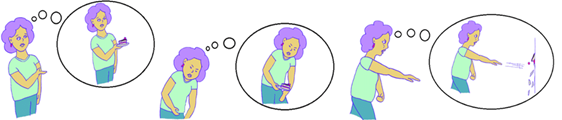
According to a recent study conducted by Moritz et al. (2023), using your mind to play with pictures of high-calorie foods can actually help you resist cravings (Moritz et al., 2022). You may be wondering how to do this? Let’s take a look at the picture, they asked participants to use their imagination to push the food out of the way (not just in their imagination, making real body movements).
CORE
This study recruited people mainly from their early to mid-50s age. Those participants were divided into different groups with different training settings. The study explored whether imagery retraining, particularly utilizing new technology (3P, named after the main treatment elements pull, pause, push), could better help individuals reduce their cravings for high-calorie food. The findings first found evidence for the efficacy of imagery retraining with the motor component in reducing food cravings. Second, the rated score of high-calorie food pictures was reduced when applying 3P technology. In short, this study suggests that the use of imaginative retraining and 3P techniques may be a promising aspect of strategies aimed at reducing food cravings.
RESEARCH METHOD
WHO?
1,106 participants (age mid-50s).
HOW?
An online randomized controlled trial was conducted, participants were randomized to one out of five conditions, including the control group and the other 4 different condition groups. Participants were shown the same photos depicting different high-calorie food and were asked to follow instructions for the imagery retraining exercise. Participants were asked to complete food craving measures and food ratings before and after training. Group 1, the passive control group was asked to only look at the photo. Group 2 was asked to close eyes and imagine a smaller photo size (Zoom-out group). Group 3 was asked to do imaginal training without actual movement (IRno). Group 4 were asked to do imaginal training with actual movement (IRpush). Group 5 were asked to imagine bringing the food close to their mouth and holding the food, and then throwing the food away with actual movement (3P). Before and after the exercise, participants were asked to rate the food pictures (‘
repulsive’ (= 0) and ‘
appealing’ (= 100)) and describe the current level of craving for high-calorie foods on a visual analogue scale (from 0 to 100).
RESULTS
- All four condition groups had statistically significant reductions in craving compared to pre-training. Among them, IRpush reduced craving the most, followed by Zooming-out and 3P.
- Only IRpush and 3P significantly and largely reduced the positive evaluation of food pictures compared to the passive control group.
- In IRpush and 3P groups, weight is a significant moderator between training and outcome. Individuals who have higher weights have a significantly greater decline in cravings compared to the control group.
DETAILS
Moritz, S., Göritz, A. S., Kühn, S., Gallinat, J., & Gehlenborg, J. (2023). Imaginal retraining reduces craving for high-calorie food.
Appetite,
182, 106431.
https://doi.org/https://doi.org/10.1016/j.appet.2022.106431
Moritz, S., Penney, D., Ahmed, K., & Schmotz, S. (2022). A head-to-head comparison of three self-help techniques to reduce body-focused repetitive behaviors.
Behavior Modification,
46(4), 894-912.
This sci-fly was written by Calorta Tan (Radboud University) for RAD-blog, the blog about smoking, alcohol, drugs, and diet.
Leave a Reply