
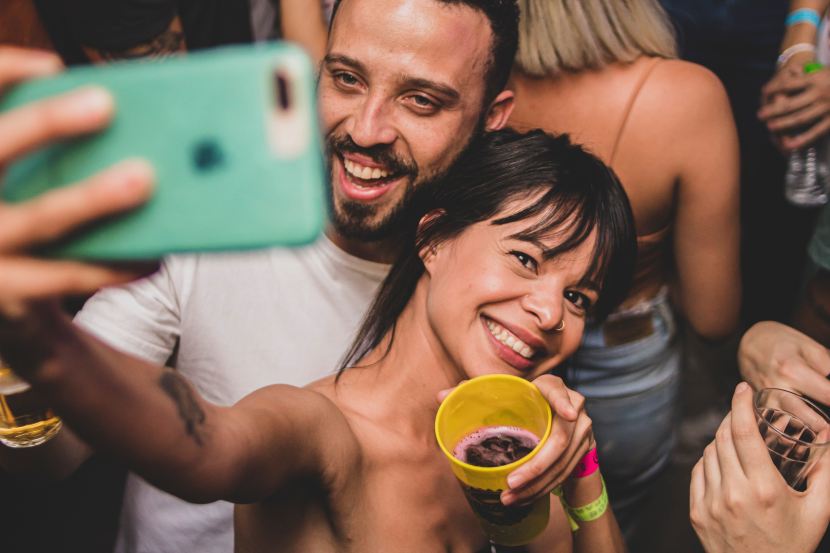
In today’s interconnected world, social media has become an integral part of adolescents’ lives, shaping how they communicate, connect, and even make decisions. However, along with its many benefits, excessive social media use has often also been linked to certain negative outcomes, for instance, an increase in alcohol use. How does that work?
Imagine this: A 17-year-old girl sitting on her bed and scrolling through Instagram. Suddenly, she comes across a post from a classmate who went out the previous night with a mix of beer, wine, and cocktails in the background. After seeing this, she feels like going out and drinking too. She texts her friend to ask if she wants to come along. The same night, they go out and post how they went out to drink on their Instagram story. This is not an uncommon sight, and many explanations exist for this behavior. Social media platforms often present an idealized reality, with posts and images showcasing people enjoying alcohol in various social settings1. Seeing these portrayals can create a sense of social pressure, influencing individuals to imitate these behaviors to fit in or be perceived as more socially desirable2. The fear of missing out (FOMO) can play a significant role, as individuals may feel compelled to participate in similar activities and consume alcohol to feel included3,4. At the same time, many social media users are passive users who consume content instead of posting it. Also, seeing alcohol-related content from non-peers leads to the same increase in potential alcohol use. Especially, the prominent presence of influencers who show excessive drinking or portray alcohol as an integral part of their lifestyle can lead to increased alcohol consumption and its normalization among their followers who share this content with each other5,6. However, while the use of social media can be associated with an increase in alcohol use, it is important to acknowledge that it can also have positive effects. Peer influence on social media does not have to lead to an increase in alcohol use. On the contrary, social media offers the development of social communities in which alcohol abstinence and support are offered7. Moreover, many influencers are aware of the impact they have on their followers. Because of this, many influencers advocate raising awareness about responsible alcohol consumption, share educational content, and provide resources for individuals struggling with alcohol-related issues. And even though more social media users interact with pro-alcohol content, pro-health messages are still seen and may counteract some of the influence of pro-alcohol content8.Overall, there can be negative effects of social media on alcohol consumption; however, initiatives can help spread accurate information, promote harm reduction strategies, and encourage responsible drinking habits by creating positive social norms through which they also learn how to drink responsibly.
This blog was written by Michelle Pingel (Research Master student Behavioural Science, Radboud University) for RAD-blog, the blog about smoking, alcohol, drugs and diet. References- Ridout, B., Campbell, A., & Ellis, L. (2011). ‘Off your Face(book)’: Alcohol in online social identity construction and its relation to problem drinking in university students. Drug and Alcohol Review, 31(1), 20-26. https://doi.org/10.1111/j.1465-3362.2010.00277.x
- Moreno, M. A., & Whitehill, J. M. (2014). Influence of Social Media on Alcohol Use in Adolescents and Young Adults. Alcohol research: current reviews, 36(1), 91–100.
- Roberts, J. A., & David, M. E. (2019). The social media party: Fear of missing out (FoMO), social media intensity, connection, and well-being. International Journal of Human–Computer Interaction, 36(4), 386-392. https://doi.org/10.1080/10447318.2019.1646517
- Riordan, B. C., Flett, J. A., Hunter, J. A., Scarf, D., & Conner, T. S. (2015). Fear of missing out (FoMO): The relationship between FoMO, alcohol use, and alcohol-related consequences in college students. Journal of Psychiatry and Brain Functions, 2(1), 9. https://doi.org/10.7243/2055-3447-2-9
- Russell, A. M., Davis, R. E., Ortega, J. M., Colditz, J. B., Primack, B., & Barry, A. E. (2021). #Alcohol: Portrayals of alcohol in top videos on TikTok. Journal of Studies on Alcohol and Drugs, 82(5), 615-622. https://doi.org/10.15288/jsad.2021.82.615
- Erevik, E. K., Torsheim, T., Vedaa, Ø., Andreassen, C. S., & Pallesen, S. (2017). Sharing of alcohol-related content on social networking sites: Frequency, content, and correlates. Journal of Studies on Alcohol and Drugs, 78(4), 608-616. https://doi.org/10.15288/jsad.2017.78.608
- Tamersoy, A., De Choudhury, M., & Chau, D. H. (2015). Characterizing smoking and drinking abstinence from social media. Proceedings of the 26th ACM Conference on Hypertext & Social Media – HT ’15. https://doi.org/10.1145/2700171.2791247
- Burton, S., Dadich, A., & Soboleva, A. (2013). Competing voices: Marketing and counter-marketing alcohol on Twitter. Journal of Nonprofit & Public Sector Marketing, 25(2), 186-209. https://doi.org/10.1080/10495142.2013.787836
Leave a Reply