
On Thursday, June 18, 2026, the big day arrived: Aafke and Nina left Nijmegen for Incheon, South Korea, to attend the 2026 conference of the International Society for the Study of Behavioral Development (ISSBD). On Sunday, June 21, the conference began with an opening ceremony and a keynote lecture on aging. The following four days were filled with symposia on a variety of topics, such as parenting, discrimination, and the effects of social media on youth.
The conference was a rich source of inspiration and information. There were many opportunities to learn about topics such as social media. Several researchers emphasized that it’s not just about screen time, but primarily about what young people do and experience online. They also stressed that the effects aren’t necessarily negative and can vary greatly from person to person. We learned about the new scientific terms “habitual smartphone use,” which focuses on habit rather than addiction, and “smartphone attachment,” inspired by the literature on attachment. The concept of “digital solitude” was also discussed: adolescents are sometimes physically alone but remain constantly connected to others through their phones.
We also learned about new research methods. For example, there was a qualitative study in which personas were created in focus groups to allow young people to talk about difficult topics in a safe and anonymous way. In addition, we saw an innovative method for collecting information on active social media use, in which research assistants followed participants’ accounts and then coded their posts using the cyberethnographic codebook1.
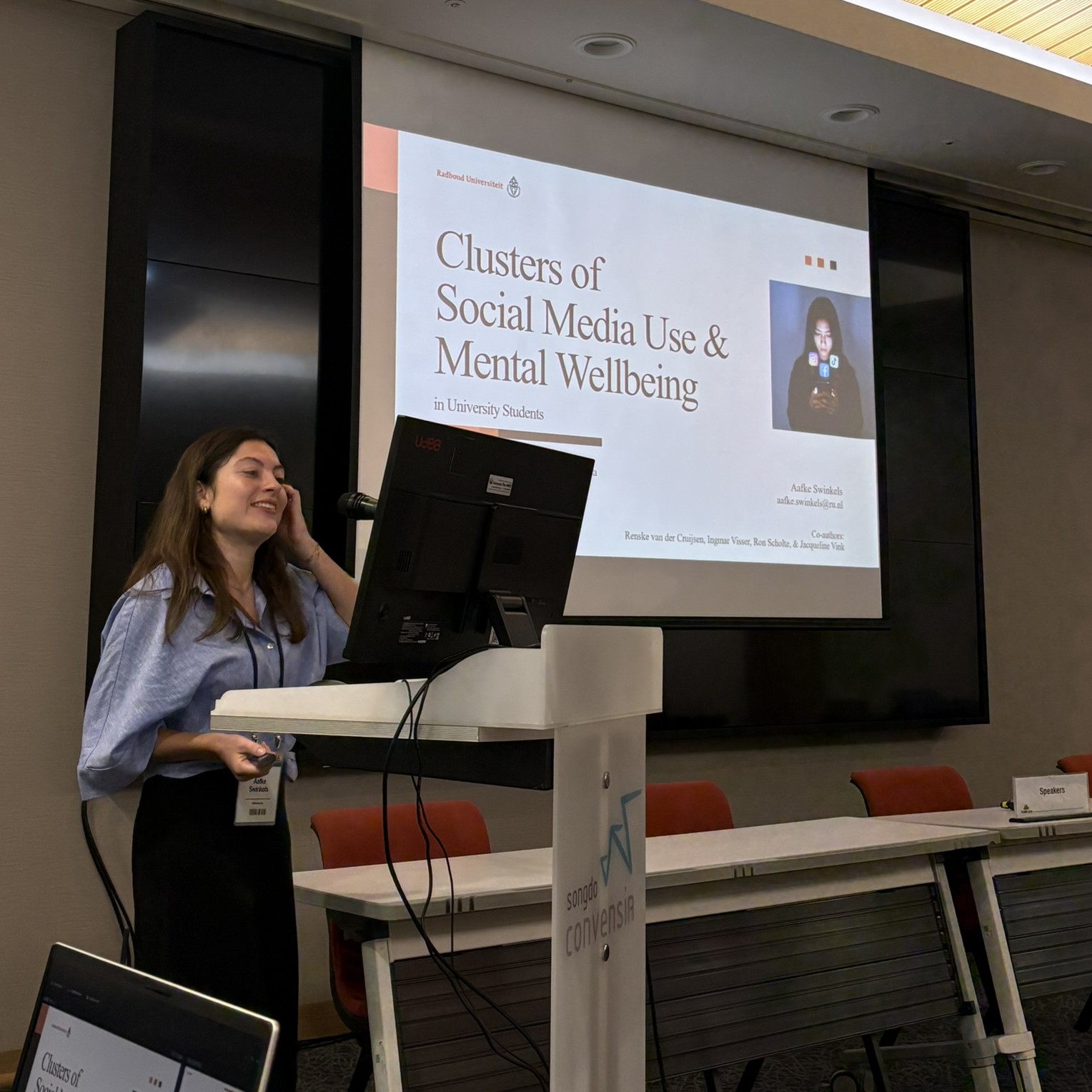
On Tuesday, it was Aafke and Nina’s turn to present. Aafke chaired the symposium: “Digital Lives of Young People: Exploring Patterns, Interventions, and Well-Being Outcomes Associated with Digital Technology Use.” The symposium combined research on the relationship between social media use and well-being with insights from intervention studies. Aafke presented her research on different social media profiles. Her findings showed that both very low use and problematic use were associated with lower mental well-being. Frequent users without signs of problematic use, on the other hand, reported higher well-being. The audience asked many questions and felt inspired.
Next, Nina presented her poster. Her poster focused on how students’ social context (such as living arrangements and online posts about alcohol) is linked to social drinking norms on the one hand and alcohol consumption on the other. This led to engaging and interesting conversations with researchers from other countries. For example, the Finnish student context and alcohol consumption appeared to have significant overlap with the situation in the Netherlands, whereas this was not necessarily the case in the United States or Kenya.
All in all, the conference gave us a lot of positive energy to continue our research. It’s good to step out of your own office bubble and connect with people from all over the world to discuss what the research actually means. As the chair of the last session we attended so nicely put it: research must be one of three pillars, alongside policy and practice. After all, what good is research if it doesn’t reach the people who need it? Together, these pillars form the foundation for helping young people grow up in the safest possible environment, where they can flourish into happy and connected individuals.

References
- Boyd K, Bliss L, Fan T, Kern K, Carlson C, Moreno M, Cascio C, Selkie E. Directly Observing and Characterizing Adolescents’ Self-Generated Social Media Posts: Protocol for Creation and Implementation of a Cyberethnography Informed Codebook. JMIR Res Protoc 2026;15:e84461. DOI: 10.2196/84461
Leave a Reply