
Over the summer, the RAD bloggers are taking some time off for a well-deserved holiday. To keep you up to date with interesting topics relating to smoking, alcohol, drugs and diet, we will be sharing some of our past blog posts and sci-flies with you again.
*Disclaimer: Please note that parts of this sci-fly have been automatically translated.*
Why do we actually have children’s champagne and non-alcoholic beer? If you ask someone this question, you often get the answer: ‘So they can join in with a drink too, of course’. But how natural is that, really? Remarkably enough, alcohol seems to stand out quite clearly from other drugs, such as smoking or ecstasy use. This distinction is particularly evident in the fact that alcohol consumption is a social and accepted behaviour in our current culture.
Think back to that time you were at a party and the birthday boy or girl announced there was no more alcohol in the house; how disappointed were you then? After all, a party isn’t complete without a nice glass of beer or wine. Or perhaps you’ve had the experience of not really intending to have another drink, but your friend persuaded you to have just one more. Why did you give in then? And what actually makes it so difficult to be the designated driver on a fun night out? All these examples show that alcohol consumption is usually associated with enjoyable occasions and that, as a result, we automatically link having a drink with a good time. And who are we to deprive our young people or pregnant women of this?
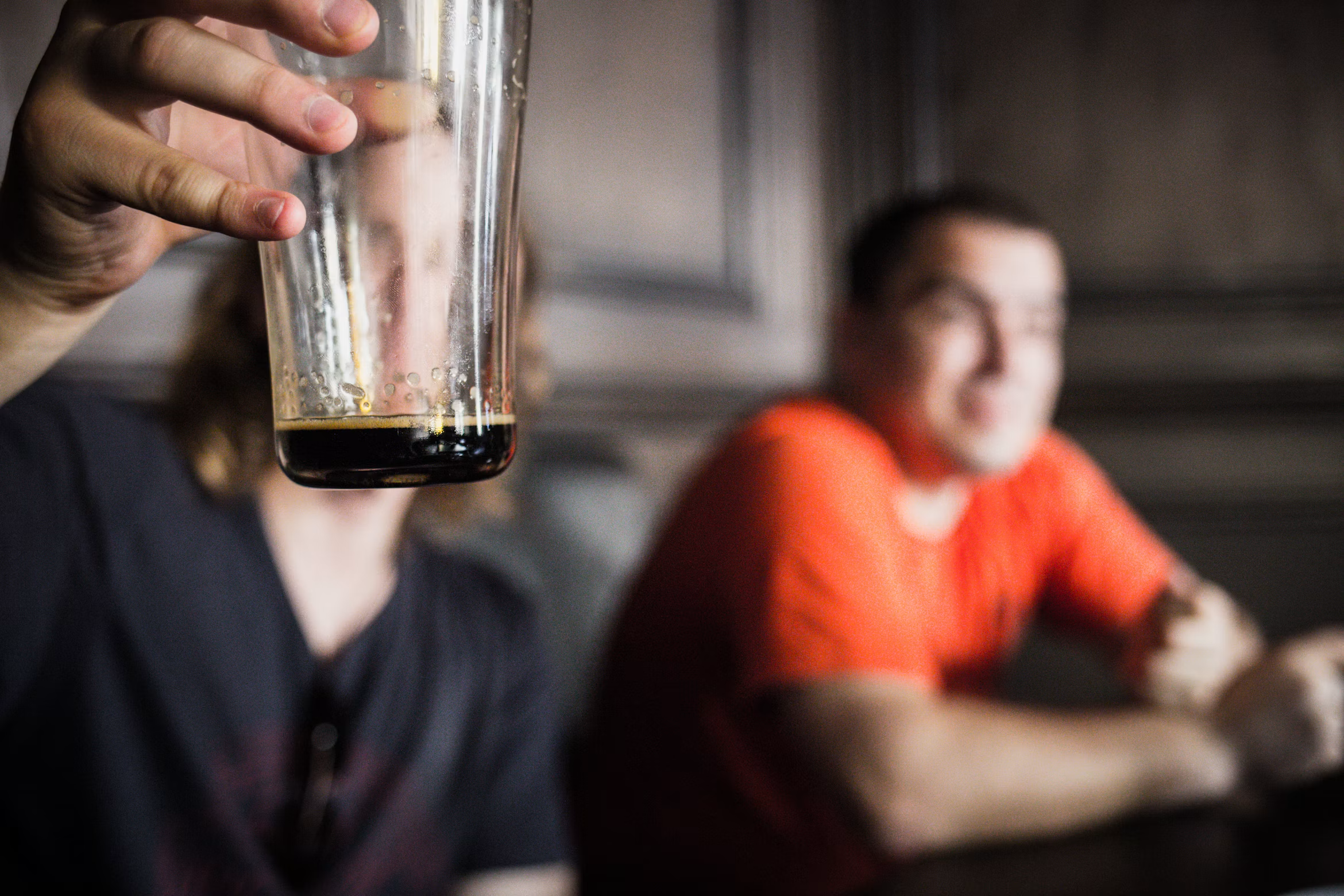
This sense of conviviality that we associate with drinking alcohol is probably one of the reasons why we allow ourselves to be influenced by the people around us when we drink. Scientific research shows that people tend to drink more when surrounded by heavy drinkers¹. By drinking the same amount, they may be trying to show that they are enjoying themselves. In addition, there appears to be an element of imitation. For instance, it has been found that people imitate an actor in a film when he or she drinks alcohol2. And this imitative behaviour was also observed later when participants were allowed to drink alongside actors in a test room that looked like a real bar. Imitation was even visible at the level of taking sips; there is a high probability that we will take a sip of alcohol about 5 seconds after our partner has done so3. So although we may be aware of it when people persuade us to have one more drink, we also drink along on a more subconscious level. It is striking that this imitation only occurs when alcohol is being consumed and not with soft drinks; the strong link with conviviality therefore seems to play a major role.
In short, drinking alcohol is a social behaviour in which we consciously and unconsciously mimic the drinking habits of those around us. After all, we find drinking alcohol a sociable activity. So if you’re planning to stay sober for the evening, try to imitate your friends as little as possible and give them a few extra compliments to make up for your drinking habits!
References
- Larsen H., Engels, R.C.M.E., Granic, I., & Overbeek, G. (2009). Imitation of alcohol consumption: Same-sex dyads. Alcohol and Alcoholism 44(3), 250-255. https://doi.org/10.1093/alcalc/agp002
- Koordeman R., Anschutz, D.J., Van Baaren, R.B., Engels, R.C.M.E. (2011). Movie alcohol portrayals and immediate alcohol consumption in a semi-naturalistic lab setting. Addiction, 106(3), 547-554. https://doi.org/10.1111/j.1360-0443.2010.03224.xDigital Object Identifier (DOI)
- Larsen, H., Engels, R.C.M.E., Souren, P.M., Granic, I., & Overbeek, G. (2010). Imitation in a micro-perspective: Alcoholic and non-alcoholic sipping. Addictive Behaviors: 35(1), 49-52. https://doi.org/10.1016/j.addbeh.2009.08.002
This blog was written on the 23th of May 2016 by dr. Martine Groefsema (Radboud University) for RAD-blog, the blog about smoking, alcohol, drugs and diet.
Leave a Reply